



You are talented at what you do. Your clients trust you with their taxes, their books, and their financial well-being. But when a new person moves to town and searches for “CPA near me” or “small business accountant in [your city],” your firm doesn’t even appear in the results.
That’s a real problem, and it costs you and your clients every day.
The truth is that most accounting firms still rely almost entirely on referrals. Word of mouth is great, but there’s a limit to it. And while you wait for referrals, potential clients are going straight to Google, clicking on the first person that pops up, and signing with them before they ever hear your name.
Google users never go past the first page of search results 75% of the time. Not a stat that you can ignore. You aren't on page 1; you are basically invisible to anyone who didn't already know to look for you specifically.
That’s where SEO for accountants comes into play. And it’s not as complicated as it sounds. No need to become a tech expert. You just need to know the basics and take a few consistent actions. This post will walk you through all of that.
What SEO for Accountants Really Means
SEO is an acronym for search engine optimization. But let’s leave the technical jargon for a second. What this really means is this: If someone is searching Google for "tax accountant in Denver" or "bookkeeping services for small business," does your firm come up?
Search Engine Optimization for accountants is the process of improving your accounting firm’s online presence so that prospective clients find you first when they are seeking financial services.
It’s a mix of a few different things:
- The technical health of your site (does it load fast, is it mobile-friendly, does Google understand what it’s about)?
- The content on your site (are your pages really answering what your potential clients are looking for)
- Your local search footprint (are you appearing on Google Maps and local results)
- Your reputation signals (reviews, mentions, backlinks from good sites)
None of this is computer science degree stuff. They just need a little attention and a little consistency.
Why It Matters Now More Than Ever
The way that people find accountants is different. It was the Yellow Pages, then referrals, then maybe a website. Google and more and more AI tools like ChatGPT are now.
Google's AI Overviews appear for approximately 40% of local queries, compared to ChatGPT conducting a live web search for 59% of prompts with local intent. This means your firm’s online presence is no longer about pleasing the Google algorithm. It needs to be visible to the AI tools people use to ask questions like “who’s the best small business accountant in my area?”
Local SEO is important for accountants, as more than 46% of all Google searches are for local businesses. If you’re a local or regional business, a good local SEO strategy is not optional. That's all. The whole game.
The good news? 56% of local businesses don’t fully optimize their Google Business Profile. That is your competition sleeping. A few clever moves put you light-years ahead of them.
5 Must-Know SEO Tips for Every Accountant
Let's get to the meat of what actually moves the needle and cut the fluff.
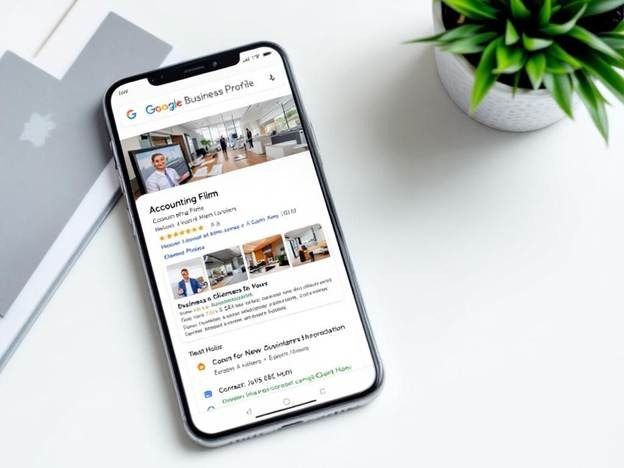
1. Claim and Develop Your Google Business Profile
This is the most effective thing you can do, especially if you’re serving a local area. When someone searches “accountant near me,” your Google Business Profile is what shows up in the map pack. It’s often the first thing a potential client will see before they even visit your website.
This is what a full profile entails:
- Your real company name (don't stuff it with keywords; Google will penalize that)
- Correct address, phone number, and hours
- Your main category is set to “Accountant” or “Accounting Firm.”
- At least 10 authentic client reviews
- Recent photos of your real office and team
- Regular posts, at least twice a month, on tax deadlines, tips, or firm news
Think of it as a second home page. For many, looking locally, it's the first thing they'll see.
2. Perform Some Basic Keyword Research
You don’t need a fancy tool to get going. Consider how your ideal client would describe their problem. They’re probably not looking for “CPA firm with QuickBooks expertise.” More likely, they are looking for:
- "accountant for small business near me" "tax preparation services [your city]"
- Accounting for LLC: "How to find a CPA for my startup”
Long-tail keywords are more specific phrases that target niche markets and tend to have higher conversion rates, as the searcher is searching for exactly what they want.
Select 2 or 3 services you want to grow and discover the phrases people are searching for. Then naturally weave those phrases into your website copy, blog posts, and page titles.
3. Build Dedicated Service Pages
This is a mistake a lot of accounting websites make. They have one big "Services" page that tries to cover everything: bookkeeping, payroll, tax planning, business advisory, and CFO services, all crammed together.
A single "Services" page trying to cover bookkeeping, payroll, tax planning, audits, and CFO advisory all at once is a missed ranking opportunity. Each page can rank for long-tail queries like "LLC tax filing help in [city]," but generic pages can't do that.
The fix is simple. Create a separate page for each service you offer. Each page should:
- Include the service name and your city in the page title and URL
- Answer the most common questions a client has about that service
- Include a clear call to action, like booking a consultation
4. Start a Blog (and Actually Keep it Updated)
Here’s the truth: most accounting firm blogs are abandoned after three posts. Don't be so hard.
Sixty percent of marketers report that inbound content, like SEO and blogs, is their highest quality source for leads. A blog does two things for you: it gives the answers to the questions your potential clients are already looking for, and it lets Google know that your site is live and authoritative.
Good blog topics for accountants are the following:
- "When should a small business hire an accountant?
- Tax Deductions You’re Missing as a Freelancer
- Checklist for Small Business Owners: How to Prepare for Tax Season
- The Difference Between a CPA and a Bookkeeper and Which One You Need
As Joe Della Mora, CEO at SEOfly, says, “If you use AI to write blogs without a purpose, the audience will not engage. One or two niche topics to demonstrate your expertise and keep your audience glued. “Don’t attempt to be the jack of all accounting trades.”
“We’re going to have to put more into it than we thought.” That’s the tone that keeps people reading, and that’s what Google rewards.
5. Create Local Citations and Get More Reviews
A citation is any place on the web where your firm's name, address, and phone number are listed. Think Yelp, Better Business Bureau, your local Chamber of Commerce, and industry directories like the AICPA CPA directory.
According to the 2026 Whitespark report, 3 of the top 5 factors in AI visibility are citation-based. This means that consistent citations feed both Google and the AI tools people use to find CPAs.
Reviews are just as important. Encourage your top clients to write a Google review. Make it easy for them by sending them a direct link. Even if your competitor has a better website, a business with 30 real five-star reviews will always outrank one with no reviews.
Technical SEO Basics You Can't Afford to Ignore
You don't need to be a deep diver on technical SEO to get results, but there are a few things that can quietly hurt your rankings if you're not paying attention.
Mobile speed: Now over 60% of searches are performed on mobile devices, and Google prefers mobile-friendly sites in its rankings. If your website is slow or difficult to use on a phone, you’re losing clients before they even read a single word.
Page titles and meta descriptions: Ensure each page on your site has a distinct title that incorporates the service and location. “Tax Preparation Services in Austin, TX | [Firm Name]” is much better than “Services” or "Home."
Secure website: Your website should be HTTPS. If a browser still says “Not Secure,” this is a red flag for Google and potential clients.
Consistent NAP: Make sure your name, address, and phone number (NAP) are the same on all platforms, including your website, your Google Business Profile, and any other directories or websites. By being consistent, Google helps to make your business information reliable.
SEO for Accountants + The AI Search Revolution
There’s something new to grab your attention. Tools like ChatGPT, Google Gemini, and Perplexity are changing the way people search for services. People ask full questions, not just keywords. “What is the best accounting firm for a small retail business in Chicago?”
The companies that show up in those AI answers have:
- Uniform citations across directories
- Powerful Google Business Profiles
- Content to answer specific questions
- Actual client reviews
Today’s good SEO for accountants is about both the traditional Google rankings and this new AI visibility layer. The strategies are very similar, so if you do the fundamentals well, you are building for both.
A Practical Timeline
SEO is not instant. That's the truth. Here's what a reasonable timeline looks like for an accounting firm starting from scratch:
Timeframe
What You Should See
Month 1-2
Optimized Google Business Profile, basic service pages published, citations started
Month 3-4
Launch of first blog posts and first long-tail keyword rankings achieved
Month 5-6
Organic traffic is increasing, and we’re improving on Google Maps
Month 6-12
Steady flow of leads from organic search, competitive visibility in local pack
The top-performing companies are those that see SEO as a long-term business investment, not a quick fix. Unlike paid advertising, SEO is an asset that builds over time and continually sends traffic without having to keep spending money on ads.
Market Trends to Know
There are a few things that are affecting the way accounting firms ought to be considering digital marketing right now:
Voice search is becoming popular. The voice recognition market will reach $26.8 billion, driving more customers to use voice-activated assistants like Siri and Google Assistant to find financial services. So your content has to answer questions in the way people actually speak, not just the way they type.
Niche wins. It is difficult to rank generalist accounting content. Businesses that develop content on specific client types, such as “accounting for e-commerce companies” or “CPA services for real estate investors,” are likely to rank faster and generate more qualified leads.
AI search is real. 84% of consumers search for local businesses daily, and 60% click on AI-generated overviews before scrolling further. You have to have enough digital presence to feed these systems, not just rank in traditional results.
Frequently Asked Questions
How long does SEO take to work for an accounting firm?
Most companies start to see tangible results three to six months after they’ve implemented a good strategy. Local SEO, particularly Google Business Profile optimization, can sometimes work faster, in four to eight weeks. It will take longer for national or very competitive terms.
Do I have to hire an agency, or can I do SEO myself?
You can absolutely start on your own, especially with Google Business Profile, reviews, and some simple blog content. As your strategy evolves or if you’re in a competitive market, working with an agency that understands both SEO and your industry can be a big lift to results.
What keywords should an accounting firm focus on first?
Begin with location-based, service-specific keywords like “bookkeeping services in [your city]” or “tax preparation for small businesses in [your city].” These are easier to rank for than broad terms and tend to attract clients who are ready to hire.
Will blogging get me clients as an accounting firm?
Yes, but the key is to write content that answers real questions your clients have, not just generic accounting topics. A post such as “What records should a small business keep for tax time?” can rank well, attract the right readers, and convert them into consultations.
Conclusion: Stop Being Invisible Online
Your accounting firm has real expertise and delivers real results for your clients. The problem is that most people who need exactly what you’re offering have no idea you exist, because they searched online and you weren’t there.
SEO for accountants isn’t about being a techie. It’s about being where your potential clients are looking. Begin with your Google Business Profile. Expand your service pages. Once a month, write one blog post answering a question your ideal client is asking. Request a review from your satisfied customers. - Be consistent.
These steps compound over time. In six months, you could be the company that shows up as number one when someone in your town types in an accountant. That’s no small beer. That’s a steady stream of new clients who trust you before they ever call.
If you want help putting these ideas into practice without spending months figuring it out yourself, the team at Progeektech builds SEO strategies specifically for service-based businesses like yours. Schedule a free strategy session, and we'll figure out how to get your firm on page one.